Productivity Game

Learn to Thrive

  • Twitter
  • YouTube
  • Purpose
  • The Academy Membership
  • My Account
Home 2015 Archives for November 2015

Archives for November 2015

Nathan Lozeron November 27, 2015

Use Your Sword

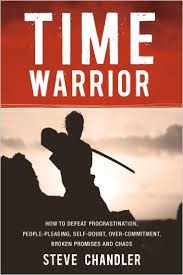
Time Warrior

Insight from the book: Time Warrior, by Steve Chandler.

Time to read: 3:52 minutes

As a Time Warrior you have one battle in life: eliminate distraction

“It’s your war against interruption and distraction.  That life is yours to create. And it never just arrives, it must be created.” – Time Warrior by Steve Chandler

A Time Warrior uses his sword to cut through distractions and carve out blocks of focus.  The warrior makes time to focus on what matters.

“How do you make time? By slowing down. Paradoxically. By creating your day. By being ruthless. With great swings and swipes of your samurai sword. You develop a brutal grace. Cutting out the unnecessary” – Time Warrior by Steve Chandler

You will never ‘find’ time for anything, if you want time you must make it. – Charles Buxton

“Management and efficiency studies in the workplace tell us that one hour of interrupted time is worth three hours of time that is constantly interrupted.” – Time Warrior by Steve Chandler

As a Time Warrior, you MUST declare war on:

  1. People pleasing
    • Saying “yes” to every request that comes your way.
  2. Thinking without doing
    • Thinking about an action without taking an action.

“A warrior takes his sword to all circumstances that don’t allow him to fully focus.” – Time Warrior by Steve Chandler

Stop People Pleasing

“I have never seen a greater time-waster then people-pleasing.” – Time Warrior by Steve Chandler

Repeat the following prayer to yourself each day: “God, spare me from the desire for appreciation and approval from others.”

“A time warrior is a peaceful warrior but a warrior still. Peaceful taking a sword to all those negative, frightening, depressing thoughts that are automatically believed… So that a great, timeless, active day can be created. A day with no time in it unless you want to make some.” – Time Warrior by Steve Chandler

Start Doing, Stop Deliberating

Our minds have the wonderful ability of simulate future action.  But letting the mind chew on your next action without doing something about is a form of mental torture.

“All fear comes from picturing the future.  Putting things off increases that fear.  Soon we are nothing but heavy minds weighing down on weary brains.  Too much future will do that. Only a warrior’s approach will solve this.” – Time Warrior by Steve Chandler

Acknowledge all internal desires and external requests for action.  Advance these actions in any way possible:  Write a quick note.  Start a new list.  Sketch a quick design,  Draft a new email.  Schedule a reminder.  Setup a meeting.

“Once I identify the big scary imagined task as a distortion produced by my own worried mind, I want to go small, as small as possible.  What can I do in the next three minutes?” – Time Warrior by Steve Chandler

Advance your ‘imagined tasks’ with short bursts of energy.  Use short swings of your sword to advance things forward and get them out of your mind for the time being.

“I am a coach by profession, and when I work with a client who is “Overwhelmed” with too much to do and not enough time to do it I will often ask him to give me an example of one of the things they are burdened by every time they think about it. The client will give me an example and we will do that thing right now. The client is amazed. The only thing missing in this client’s life was a bias for action.” – Time Warrior by Steve Chandler

“All this time that they spend thinking and feeling they could have been taking action.” – Time Warrior by Steve Chandler

Develop a bias for action: advance things forward enough to get them off your mind.

The feeling of ‘Overwhelm’ is now your cue for Action.

What if we take the wrong action?  

“In any moment of decision, the best thing you can do is the right thing, the next best thing is the wrong thing, and the worst thing you can do is nothing.” – Theodore Roosevelt

Action focuses the mind.  A focused mind generates enough energy to make progress and course correct if need be.

The Way of the Warrior

“A time warrior does not ask, “How do I feel?” but rather asks, “How can I help?” – Time Warrior by Steve Chandler

Shifting your mindset into ‘warrior mode’ puts feelings aside for the time being.  As a warrior you have a cause.  There is a reason for doing the work and that reason is greater than how you may feel at this moment.  

How can we stay true to the warrior way?  Set commitments.

“Commitments are things you keep no matter what happens to make them difficult to keep.  Commitments are powerful.  So be very selective when using them.”  – Time Warrior by Steve Chandler

The TAKEAWAY

“Time Warriors arrange the “chaos” around them by slowing down–way, way, down–and then letting go of people-pleasing, approval-seeking and every shade of mood-based and future based thinking.”  Time Warrior by Steve Chandler

What Now?

“Don’t create your year, create your day.  Figure out the perfect day and then live it.  The year will take care of itself.  So will your life.”  – Time Warrior by Steve Chandler

Before your day begins, establish boundaries that eliminate distraction.

“As a warrior [not worrier] I will wake up and create my day based on how I prefer to serve this world.”  – Time Warrior by Steve Chandler

The questions is: How “violent” of a swordsman will you be today?

“How much interrupted time will you carve out for yourself? Will you be a true time warrior? Because if you will you’ll love your timeless time. You’ll be amazed at what you can create when time is not an issue.”  – Time Warrior by Steve Chandler
Filed Under: Time Management

Nathan Lozeron November 16, 2015

The Power of Identity

Screenshot_111615_042427_PM

Time to Read: 7:42 minutes


Stuck?

Having trouble choosing between 2 or 3 ‘good’ options?

When college students are offered a choice between a ‘desired option’ and a ‘much less desired option’ (attend a lecture by a famous author OR study at the library), they chose the ‘much less desired’ option 21% of the time. When a third option is added, one equally as desirable as the first option (watch a foreign film they’ve been dying to see), the college students picked the ‘much less desired option’ (studying), 40% of the time! (Tversky, 1992) 

We all have a tendency to pick less favorable options when faced several good options.  This is due to what psychologists call ‘decision paralysis’.

When choosing between two ‘good’ options we’re more likely to select a third option that is clearly ‘less good’ simply because we don’t want the discomfort of having to decide between two similar options.

Economists recommend that we use a cost-benefit analysis approach to our decisions – weigh the options according to their expected value and pick the most rational option.  However, a cost-benefit analysis can often be a laborious task when trying to differentiate between similar options.  In many situations we either don’t have enough information to distinguish between two of more ‘good’ options OR we simply don’t have the time and energy to do so.  As a result, we typically rely on our ‘default mode’ to make decisions for us.

Default Mode

After decades of research, behavior economists and psychologists have discovered that human behavior is guided by a collection of heuristics (mental shortcuts) and cognitive biases (thinking preferences). These fallacies and biases often operate without awareness and dictate the majority of our decision-making (you can find a complete list of biases here).

Two common ‘mental shortcuts’ are loss aversion and cognitive ease.  The brain is constantly fighting to avoid loss and maintain the status quo.  It also wants to conserve energy and take the path of least effort. The result?  We avoid tough decisions and end up doing the easiest thing, instead of the most important thing.  

You may think that knowing what you should do and having a pre-defined set of goals is enough to ensure you’re making the right decisions from moment the moment…but it’s not.

In one series of interviews led by William F. Pounds of MIT, managers were asked to share the important problems they were facing in their organizations. Most managers mentioned five to eight problems. Later in the interview, they were asked to describe their activities from the previous week. Pounds shared the punch line that “no manager reported any activity which could be directly associated with the problems he had described.” They’d done no work on their core priorities! Urgencies had crowded out priorities.

– Decisive by Chip Heath & Dan Heath

Is there a way to make effective decisions throughout the day without using a systematic approach AND prevent the ‘default mode’ from taking us off track (causing urgencies to crowd out priorities)?

Yes, there is a way…and it’s something very fundamental to who we are.  In fact, ‘who we are’ happens to be the answer to our decision dilemma.

The Identity Model

In the identity model of decision making, we essentially ask ourselves three questions when we have a decision to make: Who am l? What kind of situation is this? What would someone like me do in this situation? Notice what’s missing: any calculation of costs and benefits. The identity model explains the way most people vote, which contradicts our notion of the “self-interested voter.” It helps to shed light on why an auto mechanic in Oklahoma would vote against a Democrat who’d give him health insurance, and why a Silicon Valley millionaire would vote against a Republican who’d cut her taxes. Generally, when we use the word identity, we’re talking about an immutable trait of some kind-such as a racial, or regional identity. But that’s a relatively narrow use of the term. We’re not just born with an identity; we adopt identities throughout our lives. We aspire to be good mothers or fathers, devout Catholics or Muslims, patriotic citizens, and so on.

– Switch by Chip Heath & Dan Heath

We all create stories about ourselves.  We consciously or unconsciously repeat those stories to ourselves and form an identity.  These identities reveal our values, and our values dictate our actions and decisions.

What controls our lives is the concept of identity.  It doesn’t matter what’s true, it matters what you believe.  You have a set of beliefs that control who you are.

– Anthony Robbins

It’s easy to align our choices to our identity because we have a vivid image for how someone with that identity should act.  Our identity compels us to act in the accordance of who we are thanks to a phenomenon called ‘cognitive dissonance’.

Cognitive dissonance occurs when a person experiences psychological distress due to conflicting thoughts or beliefs.

When we form an identity we establish certain expectations regarding how we should act from moment to moment.  Cognitive dissonance results from the inconsistency between our expectations and our actions. We will experience discomfort and tension until we either change our beliefs (our identity) or change our behavior.

When I became an avid runner I started to see myself as ‘a runner’.  If I had to choose between going for a run after work or going home to watch TV, I’d make the decision to go running quite easily.  If I didn’t choose to go running I would feel anxious because watch TV instead of running wasn’t consistent with who I was: ‘a runner’.  

I am often impressed by vegan’s who can resist hundreds of delicious foods that don’t align with their diet.  However, I’ve recently come to understand that it’s much easier for a vegan to stick with their diet than to eat something which isn’t consistent with who they are: ‘a vegan’.  If a vegan were to eat meat it would violate the concept of who they are as a person and they would be plagued by the discomfort of cognitive dissonance.  Their strong identity and the need to avoid cognitive dissonance allows them to filter through an array of tempting food choices with relative ease.

When we remind ourselves of ‘who we are’ we can sort through several ‘good’ options and avoid decision paralysis.  

Two Identity Types

There are two type of identities:

  1. Our individual identity
  2. The identity of our community, peer group or organization

I am a ‘Mucker’

In the late 1800’s, Thomas Edison (inventor of the phonograph and the light bulb) built an industrial research and design lab in Menlo Park, New Jersey.  The researchers in his lab  were called ‘muckers.’

As Chip and Dan Health explain in their book Made to Stick:

The term comes from two slang phrases of the time—’to muck in’ was to work together as mates, and ‘to muck around’ was to fool around. 

In any entrepreneurial organization, there’s a natural tension between efficiency and experimentation.

The term ‘muckers’ is a strategy statement masquerading as a nickname. It makes it clear that, given the tough choice between efficiency and experimentation, you choose experimentation. Why? Because you’re a mucker. Muckers don’t obsess over Gantt charts. Muckers muck.

Adopting the identity of a ‘mucker’ is an effective decision-making strategy.  The image of a ‘mucker’ is powerful and can thus guide behavior. If you’re a ‘mucker’ you have an obligation to uphold the ‘mucker’ tradition: avoid detailed planning and start mucking

We are ‘Nordies’

Nordstrom is a department store known for outstanding customer service. The management at Nordstroms wants all their employees to provide exceptional service at almost any cost.  To ensure their employees maintain a highly level of customer service they tell stories across the company to solidify the companies identity.

In the book Built to Last, Jim Collins and Jerry Porras detail a series of Nordstrom customer service stories:

– The Nordie who ironed a new shirt for a customer who needed it for a meeting that afternoon;

– The Nordie who cheerfully gift wrapped products a customer bought at Macy’s;

– The Nordie who warmed customers’ cars in winter while they finished shopping;  

When you’re a ‘Nordie’ you go out of your way to help customers, even at the expense of efficiency.  If you hold this identity in mind you will quickly make the decision between saving money and going the extra mile to increase the customer service experience.

If a ‘Nordie’ sees an opportunity to make the customers experience more pleasant, like entertaining children while a mother shops, the ‘Nordie’ doesn’t have to think long before deciding what to do next: she helps out the customer, even if her actions seem unproductive.


Reminding ourselves of our identity is an excellent decision-making strategy.  Our identity guides our behavior by eliminating all choices that don’t align with our current identity.   Thinking of our identity compels us to do that which MOST aligns with our identity, even that thing is the harder thing to do.

Being reminded that we’re a ‘mucker’ or a ‘nordie’ effortlessly leads us through the identity decision-making model:

  • Who am I? (Or, who are my peers?)
  • What is the situation?
  • What would a person like me do in this situation?

Script Your Identity

Start off by consciously forming identities in the two areas of your life:  

  • Personal life (at home, with friends and family, etc.)
  • Work life (at my desk, in meetings, etc.)

Here’s a few rules for scripting your identity:

  • Make it short and profound (like a proverb)
  • Make sure you get excited thinking about it (make it playful and a little odd)
  • Make sure it brings to mind concrete images (thinking of the identity bring several examples to mind)

Examples:

My personal role: ‘Personal Energy Generator’

  • When I’m sitting on the couch feeling lazy I stop and ask myself: “am I doing what I can to generate personal energy?”.  This usually gets me exercising or reading a book, which energizes my mind.
  • When tempted to eat fast food I always ask “will this lead to sustained personal energy throughout the day?”

My work/business statement: ‘Chief Productivity Engineer’ – helping people get more done & enjoy the process

  • If I’m deciding what article to write next I simply have to ask myself: “what will most help people ‘get more done & enjoy the process’?”
  • When tempted to check my Facebook feed I simply have to ask myself: “will this allow me to help people ‘get more done & enjoy the process’?”

Other examples:

  • A venture capitalist could spice up his identity by thinking of himself as a ‘treasure hunter’
  • A school teacher could turn-up her identity by thinking of herself as a ‘nurturer of the human spirit’

Make Your Identity Conscious

It’s important to be conscious of your identity throughout the day (remember the executives who didn’t address any of their problems?!).  If we want decision-making to be easy we need to frequently remind ourselves of who we are in any given context.  

The TAKEAWAY:

Identity is a powerful tool to guide behavior.  Being conscious of our identity allows us to navigate tough decisions with relative ease.

Now What?

Start off by establishing two identities: one for your work life and one for your personal life.

  • When you wake up, go through your list of things to do and ask: “How will I fulfill ___(my/our identity)___ today?”
  • When you get interrupted or distracted, ask: “Does this align with ___(my/our identity)___?”
  • Set an alarm to go off every hour.  When the alarm rings ask: “Am I being true to ___(my/our identity)___?”

Filed Under: All Personal Articles

Nathan Lozeron November 2, 2015

5 Productivity Lessons from a Surgeon

The main takeaways from the book: Better by Atul Gawande

Time to read: 3:48 minutes

better

What can we learn from a world class surgeon on performance & productivity?

Here are the 5 takeaways from Surgeon Atul Gawande:

Takeaway #1: ASK unscripted questions

“Ours is a job of talking to strangers. Why not learn something about them?”

– Atul Gawande

Be genuinely interested in people. Make it your mission to learn something interesting from everyone. Everyone is fascinating in their own way.

“You don’t have to come up with a deep or important question, just one that lets you make a human connection. You will find that many respond – because they’re polite, or friendly, or perhaps in need of human connection. When this happens, try seeing if you can keep the conversation going for more than two sentences. Listen. Make note of what you learn.”

– Atul Gawande

I am currently a member of a Toastmasters group.  When a new member joins the group they are asked to do an ‘ice breaker’ speech – a collection of personal stories about who they are and how they got here.  When I hear an ‘ice breaker’ speech my perceptions inevitably change. The person speaking goes from a nervous guy named ‘Doug’ to a guy named ‘Doug who has a passion for table tennis and cheers for the same hockey team I do!’.  Their stories open up an avenue for a deeper, on-going social connection.

“The children’s television host Mr. Rogers always carried in his wallet a quote from a social worker that said, ‘Frankly, there isn’t anyone you couldn’t learn to love once you’ve heard their story.’”

– Andrew Stanton, TED Talk

Takeaway #2: NEVER complain

“The natural pull of conversational gravity is toward the litany of woes all around us. But resist it. It’s boring, it doesn’t solve anything, and it will get you down. You don’t have to be sunny about everything. Just be prepared with something else to discuss: an idea you read about, an interesting problem you came across – even the weather if that’s all you’ve got.”

– Atul Gawande

I recently took on a no complain challenge suggested by author and blogger Tim Ferriss (@tferriss).  I purchased a prank handshake buzzer from eBay for $2 and put it on my keychain.  Each time I complained without proposing a solution I took out my buzzer and gave myself a little shock by squeezing the device.  It was a simple and jolting reminder to be aware my complaining.  The effects were immediate and life-changing.

WHY?

As Tim says: “Fix the words and you fix the thoughts.”

When you cut out the complaining you stop coming up with excuses and you start finding solutions.  The exercise made me much more aware of my thoughts which ultimately lead to more thoughtful and deliberate actions.

Ways to provide solutions:

  • “From now on…”
  • “Next time I will…”
  • “I will talk to…”
  • “I will learn to…”

My challenge to you – for 2 weeks, do one of the following exercises:

A) Move a ring to another finger every time you complain without providing a clear solution.

B) Put on a rubber band on your wrist and snap it against your wrist every time you complain without providing a clear solution.

C) MY FAVORITE: Put a prank handshake shock device (eBay link) on your key-chain and shock yourself every time you complain without providing a clear solution.

Takeaway #3: COUNT something

“Regardless of what one ultimately does in medicine – or outside medicine, for that matter – one should be a scientist in this world.  In the simplest terms, this means one should count something.”

– Atul Gawande

From a productivity standpoint measuring something leads you to understand it better and ultimately allows you to automate it.

“What gets measured gets managed.”

– Peter Drucker

When you measure something you automatically think of ways to improve.  If you measure aspects of your health, like your morning heart rate or your energy levels throughout the day you can’t help but think of ways to improve those metrics and improve your health.

“If you count something interesting, you will learn something interesting.”

– Atul Gawande

Takeaway #4: WRITE something

“Just write. What you write need not achieve perfection. It need only add some small observation about your world.”

– Atul Gawande

Write leads to clear thinking. When you write you naturally want to display your thoughts in a logical, sequential fashion.  The more you write the more logical and organized your thoughts become.

If you commit to posting and publishing you can’t help put nervously wondering: What will people think? Does it make sense? Was there a better way to say it? Was that interesting to my audience – if not, why not?  These questions lead to higher standards and greater personal growth.

“So choose your audience. Write something.”

– Atul Gawande

Takeaway #5: FIGHT ignorance

“Recognize the inadequacies in what you do and to seek out solutions.”

– Atul Gawande

Atul explains that doctors who cling onto what they learned in medical school or simply do what other doctors are doing are not truly serving their patients. History is filled with doctors subscribing to outdated science:

  • Frontal lobotomies were once performed for the control of chronic pain and it turned out to severally alter ones personality
  • Anti-inflammatory medication Vioxx was prescribed to people and resulted in 1000’s of heart attacks

Change is the cornerstone of growth – without a willingness to change we become stagnate.  You are either growing or dying – there is no middle ground.

Clinging to the status quo can be dangerous.  It may feel safe but when the time comes to take decisive action we will be grossly under-prepared.

Each day I aim to fight my ignorance and discover my blind spots.

“I am the wisest man alive for I know one thing – I know nothing.”

– Socrates

Always be adapting, always be changing, always be growing.


Take-home message:

“So find something new to try, something to change. Count how often you succeed and how often you fail. Write about it. Ask people what they think. See if you can keep the conversation going.”

– Atul Gawande

Filed Under: Success Psychology

Categories

newsletter

Receive the latest 1-Page PDF book summaries and a FREE copy of my ebook: "5 Steps to Finding Your Workflow"

About Me

Nathan Lozeron

Student. Engineer. Project Manager. Entrepreneur. Storyteller. Read More

Recent Posts

  • The Creative Act
  • Traction
  • Stolen Focus
  • The Expectation Effect
  • Storyworthy

Recent Posts

  • The Creative Act
  • Traction
  • Stolen Focus
  • The Expectation Effect
  • Storyworthy

Recent Comments

    Archives

    • April 2023
    • December 2022
    • October 2022
    • September 2022
    • August 2022
    • March 2022
    • November 2021
    • June 2021
    • December 2020
    • October 2019
    • June 2019
    • May 2019
    • April 2019
    • March 2019
    • February 2019
    • January 2019
    • December 2018
    • November 2018
    • October 2018
    • September 2018
    • August 2018
    • July 2018
    • February 2018
    • January 2018
    • December 2017
    • September 2017
    • August 2017
    • July 2017
    • June 2017
    • May 2017
    • April 2017
    • March 2017
    • February 2017
    • January 2017
    • December 2016
    • November 2016
    • October 2016
    • September 2016
    • August 2016
    • July 2016
    • June 2016
    • May 2016
    • April 2016
    • March 2016
    • February 2016
    • January 2016
    • December 2015
    • November 2015
    • October 2015

    Categories

    • All Book Animations
    • All Personal Articles
    • Business
    • Creativity & Innovation
    • Decision Making & Problem-Solving
    • Leadership & Influence
    • Learning & Skill Development
    • Motivation & Behavior Change
    • Success Psychology
    • Time Management
    • Uncategorized

    Meta

    • Log in
    • Entries feed
    • Comments feed
    • WordPress.org

    © Copyright 2018 Lozeron Academy Inc. Production · All Rights Reserved